
The Provincial Autonomy Movement of the Early 20th Century in China
说说二十世纪初的联省自治

By LIU Junning (刘军宁)
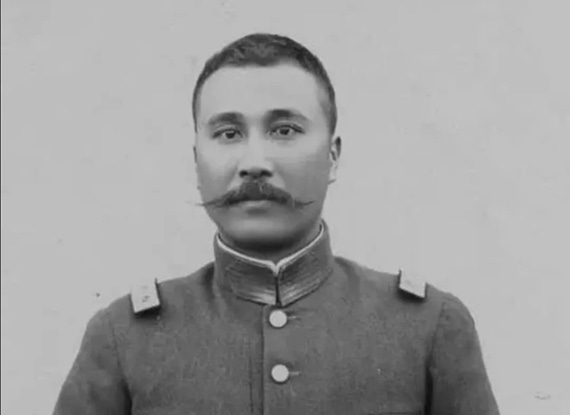
Chen Jiongming (陈炯明, 1877.12.11–1933.9.22)
【Editor’s Note: The Provincial Autonomy Movement was critical and constructive. It targeted China's millennia-old centralized authoritarianism while aiming to establish a federal constitutional democracy through provincial autonomy. The path to realization was: individuals as the basic units of autonomy; villages and towns as the fundamental units of self-governance; uniting people to form villages and towns, linking villages and towns to form cities and counties, connecting cities and counties to form provinces and states, federating provinces and states into a republic—thus reaching the realm of federal republicanism. Although the Provincial Autonomy Movement failed to lead China to a federalist society, it opened a window to glimpse the dawn of federalism and left the arduous task of continuing to search for doors and paths leading to federalism for future generations.】
The 20th century was both a century full of opportunities and an extremely unfortunate one for China. One of the greatest missed opportunities was perhaps the failure to embrace federalism. The various misfortunes China encountered in the 20th century were inseparable from the relentless pursuit and passionate embrace of centralized unification.
Reflecting on China's federalist movement in the 20th century may help China seize the opportunity of federalism in the future. Therefore, this article focuses less on historical details and more on the implications of its significance.
Since the mid-19th century, Chinese civilization has experienced a severe existential crisis, with the most critical being the crisis of institutional legitimacy and ruling authority. The authority based on violence and hereditary succession faced unprecedented challenges.
From that time, Chinese intellectuals began exploring and experimenting with various possible institutional transition plans. The institutional solution proposed by the Hundred Days' Reform was "constitutional monarchy," hoping to achieve China's institutional transition through a "constitutional monarchy" regime modeled after Japan and Britain.
The institutional solution proposed by the Xinhai Revolution was "abolishing monarchy and establishing a republic." The focus of the Xinhai Revolution was the unchanging, lofty, and hereditary imperial power, with little attention paid to institutional transitions at the local and grassroots levels.
However, the power vacuum caused by the overthrow of imperial power opened the door for various regions to explore their own institutional reforms. The transformation of the national polity from monarchy to republicanism also required corresponding institutional changes at the local level.
Thus, the emergence of the Provincial Autonomy Movement was logical. After the Hundred Days' Reform and the Xinhai Revolution successively proposed constitutional and republican institutional solutions, the Provincial Autonomy Movement set its goal of establishing a federal republican regime modeled after countries like the United States and Switzerland.
On the surface, as political transformations, the Hundred Days' Reform, the Xinhai Revolution, and the Provincial Autonomy Movement were fraught with contradictions and entanglements, especially with the revolutionary party represented by Sun Yat-sen (孙中山) outright denying both the Reformists and the Provincial Autonomy faction in action.
However, behind these three political movements lies the sequential unfolding of the same political logic: constitutionalism, republicanism, federalism, and local autonomy. These are the basic elements of modern political systems, especially in large countries.
Only through the mutual independence and complementarity of the three can an organic federal political order characterized by compound republicanism and constitutional democracy be formed.
For example, Chen Jiongming (陈炯明), one of the most active advocates of the Provincial Autonomy Movement, was a rare exemplar in modern Chinese history who embodied constitutionalism, republicanism, and federalism all in one. At that time, recognizing republicanism and constitutionalism was not easy; accepting federalism required even more extraordinary foresight.
The emergence of provincial autonomy in China was not an abandonment of constitutionalism and republicanism but a deepening of them in combination with China's national conditions. Based on the intrinsic connections among constitutionalism, republicanism, and federalism, the relevance of federalism to China's political transformation had already attracted the attention of constitutionalists during the late Qing period.
The Qing court's Constitutional Compilation Office submitted a memorial strongly advocating the establishment of provincial consultative assemblies as institutional elements of provincial autonomy:
"The essence of a constitutional regime lies in granting the people the right to participate in state affairs and to supervise administrative officials. All constitutional countries, whether Eastern or Western, regardless of differences in national form or legal system, invariably establish parliaments, allowing the people to elect representatives to express public opinion. This ensures communication between the upper and lower classes, reducing estrangement. China has never had a parliament; now that its establishment is proposed, many see it as a novelty... China is vast and populous, governed by provinces... The consultative assembly is the pivot between local autonomy and centralization; it must gather public opinion from one province without hindering the nation's sovereign unity."
Here, the petitioner has already recognized that China is vast and populous and must be governed by dividing provinces and that provincial autonomy and national unity are not contradictory.
Around the time of the Xinhai Revolution, federalist thought began to attract the attention of sharp-minded thinkers. Zhang Shizhao (章士钊) pointed out: "Observing the current grand trend, it is best for each province to first seek self-reliance... Then, collectively establish a national government above the provincial governments, following the examples of the German Federation and the United States Federation; this can be called the self-reliance of all China."
By the time of the Xinhai Revolution, such federalist thought had become a prevailing trend.
The momentum for federalism had already been accumulating at the end of the Qing Dynasty. Some have estimated that during the Wuchang Uprising of 1911, there were over 5,000 local autonomy associations nationwide. During the Xinhai Revolution, before Shandong declared independence, various associations submitted eight demands to Governor Sun Baoqi, requesting him to memorialize the Qing court, one of which was that "the constitution must stipulate that China adopts a federal national system."
Sun Yat-sen himself originally advocated federalism for China and supported provincial autonomy. Shortly after the outbreak of the Xinhai Revolution, Sun Yat-sen made a statement in Paris:
"Geographically, China is divided into 22 provinces, plus three major territories: Mongolia, Tibet, and Xinjiang, making its area larger than all of Europe. Each province has different climates, so people's habits and natures vary with the climate. Given this situation, politically, it is absolutely inappropriate to have a centralized government. It would be most suitable to adopt the federal system of the United States. Each province has complete freedom in internal affairs and bears the responsibility of governance and organization; but above the provinces, a central government is established, solely responsible for military, foreign affairs, and finance, thus ensuring cohesion."
After the success of the Xinhai Revolution, the provisional government in Nanjing drafted the Government Organization Outline based on the U.S. federal constitution. China, whether economically or socio-culturally, exhibited significant pluralistic characteristics; it should naturally have been a federalist country.
However, the conflicts among these three political movements, especially the outright denial of constitutionalists and the Provincial Autonomy faction by the revolutionary party represented by Sun Yat-sen, ultimately led to the incomplete institutional goals in China's civilizational transition, which failed halfway.
As a result, centralized unification found an opportunity to reemerge, and after a makeover, it appeared in the guise of the latest political system and remains entrenched to this day.
If we contrast the two institutional solutions of provincial autonomy and centralized unification, we find that these two lines of thought are entirely opposed and cannot coexist.
Their opposition first manifests in the nation-building approach: peaceful nation-building or forceful nation-building? In response to the situation of warlords ruling various regions in China at that time, the unificationists believed that to achieve true and complete unity in China, force was indispensable.
The Provincial Autonomy faction believed that China's unification could only be achieved peacefully—that is, federated autonomous provinces jointly forming a federal republic.
In fact, behind this divergence lies a fundamental difference in views on "what is unification." The unificationists believed that although provinces claimed autonomy, they were in fact separatist regimes by warlords; in essence, "autonomy" equated to division, and to end such division, force must be used. The Provincial Autonomy faction argued that "autonomy" was not division, and one should not equate "national unity" with "centralization."
Local autonomy would only strengthen, not undermine, national unity. Even if warlords did control certain provinces, only by abolishing military governors, nationalizing the military, and pursuing provincial autonomy could a unified and truly authoritative central federal government be established to achieve China's unification.
If force is used to unify China, the result would be replacing old warlords with new ones, substituting provincial autonomy with centralized unification, and ultimately returning to the unchanging Qin-style governance of the past two thousand years.
From the unificationists' standpoint, provincial autonomy indeed amounted to local separatism because provincial autonomy allowed localities to defy central orders in local affairs. In Chinese history, such "separatism" was always suppressed by force, occasionally tempered with co-optation.
However, in any case, absolute intolerance toward "separatism" remained unchanged. Chen Jiongming saw through the power motives behind the "forceful unificationists" and pointed out:
"Blind theorists often equate advocating 'divided governance' with destroying 'unification,' not realizing that 'divided governance' and 'centralization' are corresponding terms unrelated to 'unification.' The examples of the United States and the German Federation are clear: how can one call a deer a horse? Since the founding of the Republic, blind theorists have misunderstood 'centralization' as 'unification,' allowing ambitious individuals to usurp power under the guise of 'unification.'"
Clearly, in their view, locals must obey the central government; this was the unificationists' sole criterion for judging division and unification.
According to federalists, "autonomy" and "division" are unrelated. Autonomy is entirely legitimate, and to maintain unification, the autonomy of various regions must be respected. Once force is used to eliminate autonomy and achieve unification, unification loses its legitimacy.
The Provincial Autonomy faction repeatedly stated that what they pursued was autonomy and federalism, not separatism, let alone national division. Even during the so-called "warlord separatism" period, almost all local warlords maintained formal respect for the traditional civil service and recognition of the central government.
"Provincial Autonomy" did not aim to split China into dozens of independent provinces. The framework of a unified constitutional government still existed, and the nation maintained governmental unity in the name; warlord separatism was merely a variant of local autonomy.
"Unification" should not be misunderstood as "centralization"; "decentralization" should not be misconstrued as "division"; "autonomy" should not be mistaken for "independence."
After the Xinhai Revolution, centralization advocates like Yuan Shikai (袁世凯) and Sun Yat-sen never abandoned the path of forceful unification. Sun Yat-sen consistently insisted on the path of conquest by force, in fact abandoning constitutional republicanism in favor of seeking autocratic politics.
For Sun, military rule and political tutelage were urgent tasks, while constitutionalism was a distant prospect. Military rule was a means to establish centralized unification, and political tutelage was a means to maintain centralized unification. The notion of "tutelage" implies a self-centered, condescending attitude, with an unmistakable mindset of "I am the truth," refusing tolerance.
Sun Yat-sen was a thorough centralist among the "forceful unificationists"; his ideal was unification centered on the leader's authority. Chen Jiongming was a thorough federalist in the Provincial Autonomy faction; the ideal political system in his mind was the federalist system implemented in countries like the United States, Canada, and Switzerland.
In August 1921, Chen Jiongming promoted the election of county magistrates in Guangdong, resulting in nearly a hundred being elected. Pictured are some of the elected county magistrates.
The key factor that led to the eventual split between Chen Jiongming and Sun Yat-sen, who had fought side by side during the Xinhai Revolution, was their fundamental divergence on provincial autonomy and whether to use force to achieve unification.
Chen Jiongming's idea of "Provincial Autonomy" or "Federal Union of Autonomous Provinces" aligned with the U.S. federal system but was incompatible with Sun Yat-sen's thought that emphasized the urgent need for "one-party dictatorship" and "military rule" and "political tutelage" during the revolutionary period.
Because Chen Jiongming refused to sign Sun Yat-sen's party constitution that demanded "absolute obedience to the party leader" and refused to send troops to follow Sun in the Northern Expedition, rejecting the forceful unification of China, their split became inevitable.
Interestingly, although the Communist Party and the Kuomintang later became arch-enemies, both parties had an extraordinarily consistent attitude toward Chen Jiongming: a traitor, a traitor to centralized unification; a warlord who undermined centralization. To this day, force is still seen as the fundamental means to achieve and maintain unification.
Provincial Autonomy or Centralized Unification?
After the Xinhai Revolution, the monarchical regime symbolized by imperial power no longer existed. However, the "orthodoxy" supporting the monarchical regime in terms of concepts was not thoroughly shaken. This orthodoxy was the highly centralized unification. The deep-rooted worship of monolithic power and the fear of central power being constrained due to decentralization and autonomy did not diminish but increased.
In China's political tradition, there were basically no concepts of autonomy, divided governance, and shared governance; what was still adhered to was the unified leadership of the central government and the autocratic decision-making of the leader. From the Qing court to Yuan Shikai and Sun Yat-sen, all were the most faithful followers of this orthodoxy, regardless of the grievances and hatreds among them.
After the Xinhai Revolution, proponents of centralized unification argued that China at that time was fragmented by warlords ruling provinces, and imperialist powers attempted to partition China. The central government was incompetent, and the nation had fallen into a semi-colonial, utterly desperate state. Therefore, only through forceful unification, eliminating those social forces advocating federation and autonomy, and establishing a strong centralized government could the country have hope.
In fact, through successive revolutionary movements, the status of revolutionary leaders as "successors to the throne" was not diluted but reinforced. After 1949, the concentration of national power reached an unprecedented peak in Chinese history.
In the debate between monarchical and republican systems disappearing, what emerged was the issue of the relationship between the central and local governments: to continue the past centralized unification through force or to blaze a new trail by following the path of federal nation-building?
In the 1920s, forceful unification was no longer the only way to save the country, and Provincial Autonomy provided another feasible option for peacefully unifying China that was eagerly desired by the entire nation at that time.
After the Xinhai Revolution resolved the transition from constitutional monarchy to republicanism, China appeared as a unified but multi-centered society, forming a certain de facto federalist situation.
As early as the late Qing and early Republican period, federalism found its supporters in China. In 1897, Liang Qichao (梁启超) urged Hunan Governor Chen Baozhen to implement self-reliance and self-preservation and to carry out local reforms. Zou Rong's "The Revolutionary Army" (《革命军》) and Zhang Taiyan's preface to "The Revolutionary Army" (《革命军序》) advocated that China should follow a federalist path similar to that of the United States. By the time of the Xinhai Revolution, this federalist call was growing.
The Nanjing Revolutionary Provisional Government also clearly expressed that "the United States of America should be our model in the future." China exhibited significant pluralistic characteristics, both economically and socio-culturally; it should naturally have been a federalist country.
However, the revolutionary leaders like Sun Yat-sen and Yuan Shikai at that time continued to aspire to centralized unification through successive revolutionary movements. Sun Yat-sen and Yuan Shikai, and even the Beiyang Government, all made commitments or at least tolerated local autonomy verbally.
Regardless of Sun or Yuan, the regimes they led at the time were, in fact, multi-centered political orders akin to a federal structure. Due to the collapse of the old imperial system and the initial forced tolerance of the new regime, the autonomy of various regions burgeoned in this brief power vacuum. Thus, between 1920 and 1925, a movement emerged opposing the Kuomintang's forceful unification and advocating the implementation of a "Federal Union of Autonomous Provinces."
Starting in the winter of 1920, more than ten provinces sought autonomy and sent representatives to Beijing to petition for its implementation. In Beijing, there were two joint organizations for the autonomy movement: one was the Provincial Autonomy Union, composed of representatives from 12 provinces and Beijing City, including Jiangsu, Anhui, Jiangxi, Shandong, Henan, Gansu, Guangdong, Sichuan, Fujian, Hubei, Guangxi, and Shanxi.
Another was the Autonomy Movement Comrades Association formed by representatives from 14 provinces: Zhili, Shandong, Henan, Shanxi, Sichuan, Hubei, Hunan, Jiangsu, Jiangxi, Anhui, Zhejiang, Fujian, Guangdong, and Guangxi. Outside Beijing, Tianjin established a joint office for the autonomy movement of five provinces and one district: Zhili, Shandong, Henan, Shanxi, Shaanxi, and Rehe. Shanghai established the Shanghai Association of Provincial and District Autonomy.
The Provincial Autonomy Movement became the largest social and political movement after the May Fourth Movement and remained the only movement in Chinese history that demanded local autonomy and a federal system. Zhang Binglin (章炳麟) creatively termed China's federalist movement as "Provincial Autonomy."
The purpose of "Provincial Autonomy" was to establish a federal system. According to this political conception, if small autonomous republican bodies could be established institutionally in China's provinces, and the governing powers belonging to localities gradually returned to them while separating political parties from the state and the military, then gradually holding elections and cultivating the people's freedom and belief in democracy, thoroughly guaranteeing freedom of the press and basic human rights, a permanent federal state composed of autonomous provinces could be established on this basis.
Today, those who oppose implementing federalism in China believe that the federal system is unsuitable for China. However, during the Provincial Autonomy Movement, those who advocated federalism precisely believed that federalism was most suitable for China's national conditions. For example, Chen Jiongming believed:
"The people have never had the experience of organizing groups to express their 'collective will,' but they are accustomed to village autonomy. For China to seek democracy, it must evolve from the traditional village autonomy. We must adopt a 'bottom-up' approach and can no longer use the 'top-down' method, because for many years, China has tried the 'top-down' approach many times, and each time ended in failure. Now Guangdong is implementing divisions in villages, where police and taxation in autonomous villages are managed by the people themselves. In the future, county magistrates and provincial assembly members will be elected by the people, and assembly members will collectively elect the provincial governor. People in neighboring provinces of Guangdong will see this model and demand the same system, eventually spreading to provinces nationwide... We first unite several provinces to organize a 'Provincial Union Government,' and other provinces can join day by day, ultimately achieving the goal of 'Provincial Autonomy.'"
In the traditional centralized unification, as Chen Jiongming said, everything depends on the central government. The closer to the center, the farther from the people, not only keeping the people perpetually passive but also making it impossible to realize the central government's sincere intention to bring happiness to the people. "Local autonomy" can unleash the initiative (originality) of local people, enhance their self-confidence, and seek happiness for the locality, which is seeking happiness for the nation and the people.
In 1914, a revolutionary party member from Hubei, Gu Zhongxiu, wrote in "The Ideal Republic":
"The foundation of the nation will not waver until the local system is determined; its need is more urgent than enacting a constitution... I believe that even if we do not necessarily have the name of a federation, we must have the spirit of a federal organization so that changes in the central government do not affect localities... Do not merely use nationalism as a pretext and blindly incline toward centralization, causing China to be in misery and chaos for decades to come; this is what we earnestly pray against."
Thus, federalism was a potent remedy targeting China's millennia-old chronic ailments.
At that time, the Provincial Autonomy Movement explicitly targeted centralized unification and aimed at federalism. Chen Jiongming wrote in "Construction Strategy":
"The fundamentals of political organization lie in defining the powers of the central and local governments; the methods of definition, ancient and modern, domestic and foreign, are nothing more than centralization and decentralization. Generally, for small countries with few people, the centralized system may be feasible; otherwise, decentralization is invariably used. The United States and Germany both use the decentralized system. In the British Empire, dependencies like Australia and Canada have complete autonomy, which is even more decentralized. Russia, with vast territory and many people, practiced centralization and has now also undergone a revolution."
As he predicted, later, the Kuomintang continued to practice centralization in vast China with a large population and couldn't escape inviting "revolution," eventually having to retreat to Taiwan.
As a thought, federalism usually contains two opposing tendencies: communalism and cosmopolitanism. The former emphasizes identification with local identity, stressing local uniqueness and the right to autonomy, characterized by focusing on the "small." The latter emphasizes the need for unity and globalization among various regions, countries, and civilizations worldwide, advocating a grand unity built on fully respecting local individuality, characterized by focusing on the "big."
In the federalist political order of "uniting many into one," these two trends coexist without conflict. If only communalism exists, it will inevitably lead to small states with few people and may trigger local separatist movements. If one blindly emphasizes global unity without respecting citizens' autonomy and local autonomy, it is tantamount to bringing the entire world under a centralized world government.
Once these two tendencies are separated, they are unacceptable to federalism. From Chen Jiongming, the flag-bearer of the Provincial Autonomy Movement, we can easily find the unity of these two tendencies. He systematically outlined a bottom-up federalist political order from village autonomy to a world federation:
Nation-building: Complete the state of the entire Chinese nation, implementing the principles of "shared ownership," "shared governance," and "shared enjoyment." The Chinese nation comprises five ethnic groups: Han, Manchu, Mongol, Hui, and Tibetan. These five ethnic groups live together in China, share the same nationality, are under the same authority, and live together.
Building Asia: Form Asia into an organization, serving as a pillar for the world's grand organization. If the world seeks great harmony, Asia, America, and Europe must each unite to form three major organizations, serving as pillars for creating a grand global organization in the future. China should undertake the mission of creating a new Asian civilization.
Building the World: Enhance Chinese culture, contribute as much as possible to the world, promote international peace movements, aiming for equal and common living for all humanity. Abolish military organizations of all countries, establish a "World Federation," and China should be one of its creators.
Today in China, village autonomy has just regained attention; in Europe, the federalist European Union has already set sail.
From this, we can see that after the Xinhai Revolution, Chinese people found an integrative alternative thought that could completely replace centralized unification: Chinese-style federalism—Provincial Autonomy. This is also the only path for China to connect with the world and for Chinese civilization to integrate with world civilization.
Provincial Autonomy and National Unity
In China, one of the most severe criticisms federalism faces is that implementing federalism will lead to China's division. The Provincial Autonomy Movement at that time faced the same accusation. "Provincial Autonomy" was often denounced as warlords dividing territories for personal gain, hoarding troops for self-preservation, and undermining national unity.
In China's tradition of unification, division, and separatism, whether within the party or the country, are the most serious crimes. Demanding separate governance is treason; demanding autonomy is insubordination—practically deserving of ten thousand deaths.
In China, the fact that the federalist movement appeared under the name "Provincial Autonomy" was itself a defense against such accusations. Because concepts like "autonomy" and "federation" in traditional Chinese political culture give people an indisputable negative impression, often regarded as "heresy," supporters of federalism in China had to avoid using the term "federation."
Because in traditional Chinese political terminology, "state" (邦) can refer to a sovereign nation. Of course, some people were unwilling to abandon the term "federation." Zhang Shizhao was one of them.
He first refuted that "state" in "federation" does not necessarily and should not be understood as an independent nation composing a federal country. He believed that the "state" was principally equivalent to ancient regions or provinces in China; the only difference is that they should enjoy greater rights and powers, but not independence.
Moreover, he argued that establishing a federal country does not necessarily require the prior existence of various states; therefore, unitary states (like China) can and should transform into federal states. Zhang Shizhao refused to abandon the term "federation" because giving it up would be tantamount to surrendering to the centralized tradition and its self-proclaimed naming authority.
In fact, the purpose of Provincial Autonomy was not to divide the country but to pursue unity based on peace, freedom, and autonomy. Not a single autonomous province proposed independence; every provincial constitution affirmed that the province was part of the nation.
On June 4, 1921, Zhejiang Governor Lu Yongxiang issued a telegram advocating: "First establish the foundation of autonomy with a provincial constitution, then maintain the old view of unity with a national constitution," that is, through the implementation of provincial constitutions of autonomous provinces, to maintain national unity via the national constitution. Indeed, the key issue with centralized unification is not unification itself but becoming an excuse for some people to seize power, concentrate power, and abuse power through force.
Some also noticed that although unificationists upheld the high-sounding slogan of "maintaining unity," centralized unification did not help China's unity. In "The Pacific," a publication advocating the Provincial Autonomy Movement between 1920 and 1923, Yang Duanliu argued that in China's three thousand years of history, the time of centralized rule was actually less than a thousand years.
Rulers merely used the idea of centralized unification to deceive ignorant people, making them develop an illusory sense of security. However, once centralized unification reached its peak in each dynasty, division inevitably followed. Therefore, in the past, centralized unification repeatedly became the root cause of division in China; today, centralized unification remains the biggest obstacle to China's unity.
Advocates of Provincial Autonomy believed that "centralization" and "national unity" are not the same; "local decentralization" helps consolidate, not undermine, national unity.
They believed that only by "abolishing military governors and disarming," following the path of "Provincial Autonomy," and establishing a truly authoritative federal central government, could true unity be achieved. If force is used to unify China, replacing old warlords with new ones, the result would still be a centralized and arbitrary situation. Provincial Autonomy did not aim to split China into dozens of independent provinces.
The dispute between Provincial Autonomy and centralized unification was not a struggle between "division" and "unity" but a struggle over whether individuals have autonomy and whether localities have the right to self-govern.
By today's universally accepted political standards, autonomy is entirely legitimate; to maintain unity, the autonomy of individuals and localities must be respected. Once force is used to eliminate autonomy to achieve unity, unity loses its legitimacy.
To maintain harmonious unity across China, building a federal nation with compound republicanism is the best choice. This was precisely what the Provincial Autonomy Movement strove for.
The Institutional Blueprint of Provincial Autonomy
Since its inception, the Provincial Autonomy Movement has been fraught with significant controversy regarding its nature. Was it a scheme by warlords to carve up the nation for personal gain and division, or was it an effort to establish a unified federalist state in China? To address this debate, we might find clues by examining the institutional blueprint upon which the movement was based.
Since the late Qing Dynasty, China's pursuit of reform and change has largely been a process of choosing a political system. A major difference between Provincial Autonomy and the Hundred Days' Reform lies in their institutional models: the Hundred Days' Reform sought a "constitutional monarchy" modeled after Meiji Japan and Britain, while the Provincial Autonomy Movement aimed to establish a "federal republic" modeled after countries like the United States and Switzerland.
The Provincial Autonomy Movement drew inspiration from Western countries practicing federalism at the time, such as the United States, Canada, and Switzerland. These nations were characterized by "unity," "local decentralization," and "local autonomy" rather than "division," "centralization," or "local independence."
In 1922, Chen Jiongming (陈炯明) published an article explaining why China's Provincial Autonomy should use American federalism as its institutional blueprint:
"I advocate implementing a provincial system akin to the current federal system of the United States. Our country is vast, and ethnicities are diverse; if we rely solely on direct control by the central government, we deeply fear unforeseen complications. What's more worrisome is that if the central government encounters instability, each province will inevitably be politically affected, leading to various upheavals."
China's adoption of an American-style federal system was not only due to its "vast territory and diverse ethnicities" but also because American constitutional federalism could provide China with a means to achieve unification.
As Chen elaborated:
"The nation has been in turmoil for years; we must seek unification. However, true unification must be built upon the rule of law to endure and avoid division. The chaos in the Republic stems from unclear boundaries between central and local authorities, with military and civil administrations misaligned. Civil affairs that should be decentralized have been centralized by the central government, while military affairs that require centralization have been claimed by the provinces. To stem the source of chaos and establish order, we should start with constitution-making, borrowing from the American system to establish a federal constitution."
Therefore, supporters of Provincial Autonomy, represented by Chen, proposed:
"Adopting the American system to distribute major powers across the nation, preventing them from being monopolized by a few, thereby giving the people opportunities to participate in governance. Central authorities would be enumerated and defined, while local authorities would also be broadly stipulated. Central officials would be appointed by the government, while local officials would be appointed by the people, eliminating disputes over official appointments. Military men would no longer be able to place their own people in positions, the national treasury couldn't be arbitrarily invaded, the government wouldn't engage in conspiracies, and political intrigues would cease. Consequently, the people of each province would jointly draft provincial constitutions. Provinces would then be collectively managed by all their people, and warlords would no longer be able to claim territories for themselves, further advancing the abolition of military governors and the disarmament of soldiers."
Advocates of Provincial Autonomy at the time believed that "local autonomy," or "people's governance," was the most fundamental element of democratic politics and a prerequisite for establishing a federal system modeled after Western democracies. Thus, when Chen Jiongming promoted "Provincial Autonomy" in the 1920s, he often used the term "Federal System of Autonomous Provinces."
Provincial Autonomy, he said, was:
"Similar to the American federation, where thirteen states first achieved independence and autonomy, drafted state constitutions, convened state assemblies, and organized state governments. After internal consolidation, each state elected representatives to hold a constitutional convention (the Philadelphia Convention), producing the federal constitution and establishing the federal government, thereby laying the foundation of the United States of America, which then began to show results."
In other words, "Provincial Autonomy" takes the province as the unit of autonomy. Each provincial assembly drafts its provincial constitution, and then, following the American federal model, provinces unite to form a "Provincial Autonomous Government," establishing a permanent democratic federal government.
Although Sun Yat-sen (孙中山) strongly opposed Provincial Autonomy, he acknowledged that the movement was based on the American federal system, aiming to establish such federalism in China. In his "Three Principles of the People" (《三民主义》), he wrote that supporters of Provincial Autonomy believed:
"If China wants to be as prosperous and strong as the United States, it should adopt a provincial federation. The fundamental advantage of the American federal system lies in each state drafting its constitution and achieving self-governance. Only after the implementation of state constitutions do they unite to form the national constitution. In essence, this means transforming a future unified China into more than twenty independent units, like the thirteen independent states of the United States a hundred years ago, and then uniting them." However, in Sun's view, "Such perceptions and thoughts are utterly erroneous."
In "Three Principles of the People," Sun proposed:
"Today, how should we apply the term 'freedom'? If applied to individuals, it becomes a sheet of loose sand. It must not be applied to individuals but to the nation. Individuals should not be too free; the nation must be entirely free. When the nation can act freely, China becomes a strong country. To achieve this, everyone must sacrifice their freedom."
Contrary to the American institutional blueprint of Provincial Autonomy, Sun chose the Soviet-style one-party dictatorship as his model, accelerating the return to China's traditional centralized unification and aligning with Soviet-style socialism. This led to the suppression of the Provincial Autonomy Movement and the new policy of "allying with Russia and the Communist Party, and supporting workers and peasants."
Had Sun Yat-sen not received support in the form of guns, money, and modern totalitarian ideology from his northern neighbor, enabling him to successfully use force to eliminate the Provincial Autonomy Movement, China might have objectively faced the opportunity for federalism in the twentieth century.
On the other hand, by basing the Provincial Autonomy Movement on American federalism, the movement aimed to establish a unified country like the United States, not to dismember China through division and fragmentation.
Supporters of Provincial Autonomy had valid reasons for choosing American federalism as their institutional blueprint. The situation in post-Xinhai Revolution China was indeed strikingly similar to the political landscape in the United States after its War of Independence:
After the founding of the Republic of China, the central government was extremely weak, much like the nominal Confederation Congress during the American Revolution. Both countries exhibited political structures with multiple centers of power: thirteen independent states in the U.S. and twenty-two provinces in late Qing China that had sought independence. In this sense, the Xinhai Revolution was, to some extent, similar to the independence revolutions of the North American colonies.
Following the colonial revolution in North America, there was a grand debate on the choice of political systems. In this debate, the Federalists, who advocated federal nation-building, prevailed, while those who wanted each state to maintain independence eventually conceded.
Similarly, after the Xinhai Revolution, China experienced a major debate: whether to follow the traditional path of centralized nation-building through force or to adopt the American-style federalist and peaceful nation-building approach.
Supporters of the Provincial Autonomy Movement chose the latter but were ultimately defeated by those advocating forceful unification. Americans seized the post-revolution opportunity to choose federalism, while Chinese revolutionaries continued the long-standing tradition of centralized unification. The consequences of these different choices are fully evident today.
Provincial Autonomy and the Provincial Constitution Movement
Federalism is a political order constructed from the bottom up, characterized by individual autonomy, local self-governance based on division, and co-governance by member entities and citizens at the national level. Therefore, local autonomy is an indispensable step toward federalism.
To implement federalism in a traditionally centralized China, only through local autonomy can the top-down imposed centralized political order be transformed into a bottom-up federalist political order.
In China, the provincial level is the pivot that determines whether the political order is top-down or bottom-up. Therefore, whether provinces can achieve autonomy is an important indicator of whether the political system is federalist or centralist.
Under centralization, provincial leaders (such as the former governors and military governors) were appointed by the central government. They represented the power and interests of the central government and exercised ruling authority in each province as its representatives.
In such a centralized governmental order, governance at all levels belonged to the central government; local affairs were decided by the center. Under federalism, provinces should be autonomous, with local affairs decided and managed by local people themselves.
Provincial administrative heads (referred to as governors in Provincial Autonomy) were elected by provincial voters (directly or indirectly). The governor's power did not come from the central government but from the voters of the province.
If provinces could achieve autonomy, the two-tier government essential for federalism would naturally take shape. The transition from provincial military governors to governors required constitutional implementation. Constitutionalism was a prerequisite for realizing federalism and provincial autonomy.
Therefore, whether establishing a federal system at the national level or implementing autonomy at the provincial level, one must start with drafting a new constitution.
One of the essential elements of the provincial federation was the provincial constitution. In the 1920s, the logical necessity of implementing federalism in China was to draft provincial and national constitutions. The movement to establish provincial constitutions became an important part and hallmark of the Provincial Autonomy Movement. It was natural that during the movement, there arose campaigns demanding the drafting of provincial constitutions.
This movement formed a wave between 1920 and 1925. Provinces like Hunan, Zhejiang, Yunnan, Sichuan, and Guangdong all drafted provincial constitutions. Others, such as Hubei, Guangxi, Fujian, Shaanxi, Shanxi, Guizhou, Jiangxi, and Jiangsu, were actively brewing constitutional autonomy.
The 1921 constitutional movement in Hunan was the starting point of the Provincial Autonomy Movement. Provincial Autonomy, especially the movement to draft provincial constitutions, was the first comprehensive awakening of provincial consciousness in Chinese history.
The draft of the Hunan Provincial Constitution was completed in April 1921, passed by the Review Committee in August, approved by a province-wide public vote in November, and promulgated on January 1, 1922. The Hunan Provincial Constitution comprised 141 articles across thirteen chapters. Below is an outline of its structure:
Preamble: "The people of Hunan Province, to enhance happiness and consolidate the foundation of the nation, hereby establish the constitution as follows..."
Chapter One: General Principles
Hunan is an autonomous province of the Republic of China, with its existing territory as its domain. The right of provincial autonomy belongs to all provincial citizens.
Chapter Two: Rights and Duties of the People
All people are equal before the law, without distinction of gender, race, religion, or class. People have the right to protect their bodily rights and lives, the right to protect their private property, the right to protect their residences, freedom of occupation, the obligation to receive education, etc.
Chapter Three: Provincial Powers
Includes local systems and supervision of local autonomy, formulation of household registration and registration laws, protection of mining, agriculture, and forestry, military and administrative affairs within the province, provincial police administration, etc.
Chapter Four: Provincial Assembly
Composed of members directly elected by all provincial citizens. Citizens over thirty years old are eligible to be elected as provincial assembly members. The term is three years. There is one speaker and two deputy speakers; a standing committee is established when not in session. If the governor commits major crimes, assembly members can propose impeachment.
Chapter Five: Governor and Provincial Council
Governor: The provincial administrative power is exercised by the governor and the Provincial Council. The governor is elected by the Provincial Assembly, which selects four candidates to be voted on by all provincial citizens, with the one receiving the most votes being elected. The elected governor is then appointed by the patriotic government. Any Hunan citizen over thirty-five years old who has resided in Hunan for more than five years is eligible. If an active military officer is elected, he must resign from his current position before assuming office. The governor's term is four years, and he can be re-elected once. The governor's powers include promulgating laws and issuing orders for their execution, commanding the provincial military and managing provincial military affairs, and appointing and dismissing all provincial civil and military officials.
Provincial Council: Under it are the Departments of Internal Affairs, Finance, Education, Industry, and Justice. The Provincial Council is located within the governor's office. The governor is the head of the council, and each department head is a council member. Department heads serve three-year terms. The governor is responsible to the Provincial Assembly for policy decisions made by the council's political meetings.
Chapter Six: Legislation
Chapter Seven: Administration, including finance, education, industry, military, etc.
Chapter Eight: Judiciary
Chapter Nine: Audit Office
Chapter Ten: Outline of the County System
Chapter Eleven: Outline of Municipal and Township Autonomy
Chapter Twelve: Amendment and Interpretation of the Constitution
Chapter Thirteen: Supplementary Provisions
Before provincial laws are promulgated, the existing laws of the Republic of China and orders based on those laws that do not conflict with this constitution shall still apply to this province. Before the national constitution is implemented, matters that should belong to national authority may be decided and executed by the Provincial Assembly.
The Hunan Provincial Assembly was composed of members indirectly elected by all provincial citizens. Those eligible for election included: 1) Graduates from specialized schools at home or abroad; 2) Those who had held recommended positions for over a year or appointed positions for over three years without fault; 3) Those who had served as provincial or county assembly members for over three years; 4) Those who had served as principals or teachers of secondary schools or higher for over two years; 5) Those who had held positions in provincial or county public organizations for over five years. The number of provincial assembly members was temporarily set at 108, divided into three major districts with 37, 36, and 35 members, respectively.
The Hunan Constitution (known as the Xiang Constitution) adopted a listing approach for provincial powers. Since federal countries like the United States and Switzerland had states first, which then formed a nation, when they organized a federation, they ceded some of the original state powers to the central government.
Therefore, in the constitutions of these federal countries, the central government's powers are naturally enumerated, leaving residual powers to the states. Even at that time, some had noticed that "the state constitutions of Virginia and Massachusetts in America, and Geneva in Switzerland, were all established before the national constitution..."
However, in the 1920s, China's provinces had no fixed legal powers to speak of, and there was no federal constitution at the national level to reasonably divide vertical powers. In this situation, the drafters of the provincial constitution had to list provincial powers in advance, clearly defining the province's status; this not only gave provincial autonomy a certain scope of activity but also laid a foundation for the future division of powers between the two levels of government when drafting a federal constitution.
The Hunan Provincial Constitution can be said to be the most radical provincial constitution that appeared in China. It included universal suffrage, provincial and county assemblies, educational freedom, and judicial independence. The governor was popularly elected, and voters enjoyed the rights of initiative, referendum, and direct recall.
From the provincial constitutions that were drafted, they shared common features: emphasizing the protection of citizens' basic rights, restraining the powers of administrative heads at the provincial and county levels, implementing autonomy at the county and village levels, and prohibiting military interference in politics. Respect for national unity and territorial integrity was particularly prominent; not a single province demanded independence from the Republic.
Article One of the Hunan Constitution stipulated: "Hunan is an autonomous province of the Republic of China." The preamble of the Sichuan Constitution declared, "Sichuan is an autonomous province of the Republic of China." This was identical to the provisions in the provincial constitutions of Hunan, Zhejiang, and Guangdong. This indicates that provincial constitutional autonomy was not about splitting the Republic of China into independent countries; drafting provincial constitutions was a step toward unifying the nation and organizing a federal political system.
Therefore, the function of the provincial constitution was, on one hand, to pave the way for the permanent unification of the country on a federalist basis, and on the other, to reverse centralization, eliminate the autocratic power of provincial military governors, and provide a legal foundation for autonomy below the provincial level.
An important task of the provincial constitution movement was to abolish military governors and eliminate the legitimacy of their power because if the provincial level did not continue to decentralize downward, it could create an "independent and autocratic small kingdom," which would be completely contrary to the goals pursued by federalism.
Although provinces later encountered various expected and unexpected setbacks during the constitutional implementation process, and Provincial Autonomy and provincial constitutions ultimately became casualties of Sun Yat-sen's Northern Expedition, the epoch-making significance of the provincial constitution movement in a China so deeply rooted in the tradition of centralized unification cannot be overstated.
This political legacy will undoubtedly receive special appreciation in China's future federalist movements. It can be said that as long as China follows the path of federalism, provincial constitutions will certainly be brought back to the agenda.
An Attempt at Provincial Autonomy: Guangdong in 1921
The Provincial Autonomy Movement of the 1920s had two main implications: first, to find an overall institutional solution for China's peaceful unification; second, to lay an experiential foundation for realizing federalism in China through the practice of autonomy in various provinces.
Therefore, the Federalist movement inevitably needed to be implemented in concrete social practices. Guangdong is undoubtedly a highly representative point of observation when observing the practice of provincial autonomy in China.
In the 1920s, Guangdong Province had a population of 30 million (equivalent to five modern-day Switzerland in terms of population). The province had ninety-two counties, with an average population of over 300,000 per county. The period under consideration here is Guangdong in 1921.
What impression did Guangdong's autonomy movement leave on outside observers at the time? In a report submitted to the U.S. Secretary of State on September 16, 1921, the American Minister to China, Jacob Gould Schurman, indirectly revealed some clues. The report stated:
"The Southern Government has established a highly efficient modern municipal government in Guangzhou while actively pursuing local autonomy throughout the province. They declare that their doctrine is to establish a federal government through Provincial Autonomy. Guangdong is currently undoubtedly one of the most enlightened provinces in China and possibly one of the most efficiently governed."
What events occurred in Guangdong that year to warrant such an evaluation? Here is a summary of major events related to Provincial Autonomy:
December 1920: Issued the "Provisional Regulations for the Election of County Magistrates and County Assembly Members."
February 1921: The Provincial Assembly reviewed the report on the "County Autonomy Regulations."
June 1921: The initial draft of the constitution was completed.
September 1921: The election of county assembly members was completed.
November 1921: The election of county magistrates was completed.
December 1921: The Provincial Assembly formally passed the "Draft Constitution of Guangdong Province."
The foremost event of that year was that Guangdong had its first provincial constitution in history. This provincial constitution had two major characteristics: first, it included a special chapter stipulating the basic rights of citizens; second, it greatly limited the powers of the governor as the representative of executive authority. For example, the governor had no veto power over assembly resolutions, and the assembly had the power to impeach the governor. The purpose of drafting the provincial constitution was not independence but autonomy.
Therefore, it stipulated that when the nation declared war, part of the provincial army would be subject to the command of the (central) government; it prohibited active military personnel from interfering in politics. To control the size of the government, the provincial constitution stipulated that Guangdong would implement a two-tier government system of provinces and counties, plus special municipalities.
The provincial constitution not only provided for autonomy at the provincial level but also stipulated that county magistrates and county assembly members would be directly elected by citizens. Special municipalities would have five councilors in charge of municipal affairs and establish a municipal assembly.
Having a constitution without concrete institutions is merely a piece of paper. After establishing the constitution, the next step was concrete institutional construction. With the provincial constitution, the foundation for autonomous institutions at all levels was laid. Since it was autonomy, it had to proceed from the bottom up. In China, autonomy should naturally start from villages and towns, gradually developing to encompass entire counties, provinces, and the nation.
In 1921, Guangdong began implementing autonomy at the village level. County magistrates and provincial assembly members were also elected by the people; police and taxation in autonomous villages were managed by the people themselves. Step by step, autonomy was implemented throughout Guangdong.
The popularly elected county magistrate was the administrative head of a county. Judging from the county's powers listed above, the county magistrate bore enormous responsibilities and powers over all local affairs. In implementing the popular election of county magistrates, the election regulations included an interesting provision: voters had to perform three days of labor (or pay to substitute labor) to qualify to vote, and much of this labor was used to build provincial highways.
What autonomy rights should a county possess? Let's look at the county powers listed in the Draft Constitution of Guangdong Province. There are eleven items, with education and industry at the forefront:
Managing normal schools, middle schools, advanced national elementary schools, kindergartens, part-time schools, various special schools, lecture halls, libraries, museums, art galleries, and other educational matters.
Encouraging agriculture, sericulture, fishery, animal husbandry, land reclamation, afforestation; operating and supervising public and private industries; establishing various exhibition halls and experimental fields; and other matters related to industry.
Dredging rivers and lakes, constructing embankments, canals, sea walls, and roads; and other matters related to water conservancy and transportation.
Constructing and managing public buildings and all public civil, electrical, and gas engineering projects.
Managing county banks, various insurance cooperatives, and other public enterprises.
Cleaning streets and slaughterhouses, maintaining public parks and cemeteries, and other public health matters.
Managing charitable services such as granaries, medical aid, infant care, widows' relief, elderly care, care for the disabled, protection of workers, and other public welfare and charity matters.
Managing police, militia, and other security matters.
Investigating household registration, births, deaths, marriages, and other statistical matters.
Executing administrative matters entrusted by higher authorities and the collection and execution of various matters.
In theory, the step-by-step autonomy from villages to provinces is the basic component of a compound republic. Implementing autonomy at the local level changes the nature of local administrators from embodiments of top-down governance representing higher authorities to embodiments of people's governance representing the populace.
According to Chen Jiongming, the governor of Guangdong at the time:
"The popular election of county magistrates adopts the spirit of people's governance; being directly elected by county citizens aligns with the essence of people's governance and does not require selection by the governor."
Under the concept of local autonomy, Guangdong implemented autonomy in villages, with police and taxation managed by the people themselves. The entire Guangdong resembled a small-scale compound republic, orderly from village to province.
The major events that occurred in Guangdong that year were not unrelated to significant events concerning China's modern institutional transformation. The larger picture behind them partially originated from Guangdong's local autonomy and the Provincial Autonomy Movement.
In Guangdong, the goal of this movement was to build Guangdong into China's model province by "setting an example to inspire confidence." That year, Guangdong became a focal point for new political experiments, such as drafting a provincial constitution, popularly electing county magistrates, implementing village autonomy, judicial reform, educational reform, and prohibiting opium and gambling. Given what was accomplished in Guangdong that year, the American minister's conclusion is not surprising.
On May 5, 1921, Sun Yat-sen issued a telegram upon assuming the presidency elected by the Extraordinary Parliament, expressing support for this Provincial Autonomy. The telegram stated:
"To resolve the perpetual dispute between the central and local governments, only by enabling the people of each province to achieve autonomy, draft their own provincial constitutions, and elect their own governors. The central government should delegate powers to the provinces, and the provinces should delegate powers to the counties, so that the already fragmented republic can be reunited through the principle of autonomy, returning to unity."
It was later he who ended Guangdong's autonomy movement of 1921.
In modern China, Guangdong has had a particularly significant influence on China's institutional transformation, with figures like Kang Youwei, Liang Qichao, and Sun Yat-sen well-known to all. However, few have spoken about the special significance of Guangdong in 1921. After the interlude of 1921 ended, Guangdong returned to the past and also returned to the future.
Many of the major initiatives undertaken that year—some of which have only just begun again today, such as Guangdong's recent experiments with electing township heads—may have to wait longer to restart (like provincial constitutions). The road not completed that year will certainly be continued in the future.
Provincial Autonomy: Supporters and Opponents
For a long time, Provincial Autonomy was considered a "divisive" and "separatist" movement, and its supporters were believed to be limited to "ambitious" and "ill-intentioned" local "warlords," which seemed to be a sufficient reason to reject Provincial Autonomy.
If we talk about warlords, almost every politician at that time was a warlord. If we consider involvement in military affairs, which politician did not meddle in military matters? From the late Qing to the Republic, both central and local governments were institutionally unified in military and political affairs; local leaders at that time could be said to be warlords. Regardless of whether they were "warlords," the rise of Provincial Autonomy in China was indeed supported by many local influential figures.
From local attempts in various provinces to the development into a nationwide movement, Provincial Autonomy was inseparable from the tireless advocacy of liberal intellectuals. In September 1922, Hu Shi (胡适) proposed the suggestion of "establishing a unified federal state based on provincial autonomy." Liang Qichao (梁启超), Cai Yuanpei (蔡元培), Zhang Binglin (章炳麟), and Zhang Shizhao (章士钊) all passionately promoted Provincial Autonomy. Scholars like Zhang Dongsun, Ding Shize, and Pan Lishan published articles supporting federalism.
In the 1920s, six professors from Peking University—Ding Xielin, Wang Shijie, Li Siguang (李四光, also known as Zhongkui), Li Shizeng (李石曾), Li Linyu, and Tan Xihong—jointly suggested that China should temporarily implement a "confederation" to lay the foundation for establishing a permanent "federation."
The support of many liberal intellectuals for Provincial Autonomy also indicates that this movement was not an armed separatist movement by local warlords. Otherwise, were so many liberal intellectuals too naive to see through the "evil intentions" of warlords pretending to advocate "Provincial Autonomy" for the sake of "separatism"?
In none of the provinces did the Provincial Autonomy Movement get overthrown by internal uprisings; instead, it was suppressed by external military force. This suggests that, at the very least, the populace was not strongly opposed to Provincial Autonomy. Not only that, but more instances show that the public actively supported Provincial Autonomy.
American sinologist Prasenjit Duara (杜赞奇) found that the autonomy movement received massive support in Hunan and Guangdong. Students, intellectuals, and emerging professionals like journalists, educators, businessmen, and provincial assembly members quickly embraced the new slogans.
The most forceful opponents of the Provincial Autonomy Movement were often those who had sympathized with Provincial Autonomy or local autonomy before they gained actual political power, such as Yuan Shikai (袁世凯), Sun Yat-sen, Chen Duxiu (陈独秀), and Mao Zedong (毛泽东).
Among them, Sun Yat-sen initially recognized local autonomy but later believed that Provincial Autonomy hindered his Northern Expedition to unify China by force. In his later years, Sun held a very hostile attitude toward Provincial Autonomy and even federalism, harshly criticizing Provincial Autonomy in his "Three Principles of the People."
Chen Duxiu participated in Chen Jiongming's autonomous Guangdong provincial government and was in charge of education, but later became one of the loudest opponents of Provincial Autonomy. He advocated organizing a strong political party to unify China by force. At this time, he was secretly organizing the Chinese Communist Party to realize his vision.
According to Duara's view, Chen Duxiu's real intention was not because military men like Chen Jiongming obstructed the establishment of a federal nation, but because they were unwilling to follow the comprehensive revolutionary slogans of communism.
Like Chen Duxiu, the Chinese Communist Party initially sympathized with federalism. As early as the declaration of its Second National Congress in 1922, the CCP explicitly proposed "unifying China's mainland, Mongolia, Tibet, and Xinjiang into a Chinese Federal Republic through a free federal system." Mao Zedong in Hunan also actively responded to the Provincial Autonomy Movement, advocating that Hunan follow the path of Provincial Autonomy.
The above opponents of Provincial Autonomy (both individuals and parties) shared a common characteristic. The more urgently they sought political power, the closer they were to political power, and the more power they held, the more opposed they became to local autonomy, Provincial Autonomy, and federalism.
This also, conversely, proves that Provincial Autonomy, as a federalist initiative, indeed played a restrictive role on centralized and unified power. Therefore, those who pursued centralized, unrestricted, and indivisible absolute power were all opponents of Provincial Autonomy.
In short, those who love autonomy and freedom favor federalism; those who seek power and dictatorship dislike federalism.
Provincial Autonomy: From Past to Future
The Provincial Autonomy Movement of the early twentieth century can be said to be the most valuable political attempt in China during that century because it integrated constitutionalism, republicanism, and federalism into a cohesive institutional package. It provided a concrete operational vehicle for federalism in China and achieved significant success in a short period.
However, this most valuable institutional treasure received the least recognition and was most denigrated. Subsequently, the nation's fate was fraught with misfortune; the Chinese people suffered hardships, and institutional transformation repeatedly failed to materialize, which is not surprising.
The Provincial Autonomy Movement was the only attempt in modern Chinese history to open the door to federalism. This door was closed by Sun Yat-sen and the Kuomintang in alliance with the Soviet Union through military force.
The failure of the Provincial Autonomy Movement planted the seeds of China's twentieth-century tragedy. Its failure had profound social and historical roots. After all, federalist thought surpassed the cognitive level and acceptance capacity of many politicians and intellectuals of that era. Liberal federalist thought ultimately failed to overcome the autocratic ideology of centralized unification.
Duara pointed out: Centralization advocates and centralizing radicals colluded to bury the federative movement under the pretext of betrayed ideals and insinuations. When the Nationalists and Communists joined forces in the Northern Expedition, sweeping through the central and southern provinces, they eradicated provincial constitutions and assemblies to pave the way for establishing a centralized state, removing obstacles.
China's tragedy lies not only in the failure of Provincial Autonomy but also in choosing a modernized, Western-thought-armed, unprecedentedly centralized unification, reconstructing a "Qin system" armed with Western totalitarianism.
Although Provincial Autonomy failed, it had immeasurable value. The movement exposed the root cause of China's political ailments: the autocratic centralized unification that has persisted for millennia. It also provided the main remedy: the compound republic of federalism. Only federalism can interrupt the unchanging political and ideological traditions of centralized unification. The Provincial Autonomy Movement was merely the first formal attempt at such a transformation.
Another extremely valuable aspect of the Provincial Autonomy Movement was that some local leaders who supported it voluntarily sought to limit their own power through constitutions (provincial constitutions). This phenomenon has been almost entirely overlooked by researchers.
Throughout history, both ancient and modern, with few exceptions, rulers have seized every opportunity to expand their power, including using constitutions. It is rare to see constitution-makers and leaders consciously limiting their power without external pressure or internal competition, as this is only seen among the founding fathers of the United States and some practitioners of Provincial Autonomy in China.
In China, it has become an almost irreversible historical inertia for those in power to use all means, including constitutions, to expand their power. The fact that practitioners of Provincial Autonomy could act against this historical inertia is exceptionally commendable and requires immense courage.
The implementation of federalism and constitutional democracy in China's future largely depends on whether the constitution-makers and leaders at that time are willing to have their governing powers constrained by the constitution. In this regard, the practitioners of Provincial Autonomy are forever exemplary models.
Choosing centralized unification stems from the rulers' pursuit of personal power; the choice of centralized unification is the leaders' choice for their personal interests while choosing federalism arises from a concern for the nation's fate and the people's well-being. The direction of Provincial Autonomy was contrary to the ambitions of the autocrats of the time.
In China, "separatism" leads to war not because of separatism itself but because of the desire of various parties to unify. In early twentieth-century China, various political movements surged, some of which were critical, such as the nationalist movement and the anarchist movement; some were not only critical but also destructive, like the totalitarian movement.
However, the Provincial Autonomy Movement was both critical and constructive. It targeted China's millennia-old centralized authoritarianism while aiming to establish a federal constitutional democracy through provincial autonomy.
The path to realization was: individuals as the basic units of autonomy; villages and towns as the fundamental units of self-governance; uniting people to form villages and towns, linking villages and towns to form cities and counties, connecting cities and counties to form provinces and states, federating provinces and states into a republic—thus reaching the realm of federal republicanism.
Although the Provincial Autonomy Movement failed to lead China to a federalist society, it opened a window to glimpse the dawn of federalism and left the arduous task of continuing to search for doors and paths leading to federalism for future generations.
Originally published in "Strategy and Management" magazine.